Physics
Physics
The Physics of Sunlight II: The Ghosts the Sun Sends Through You
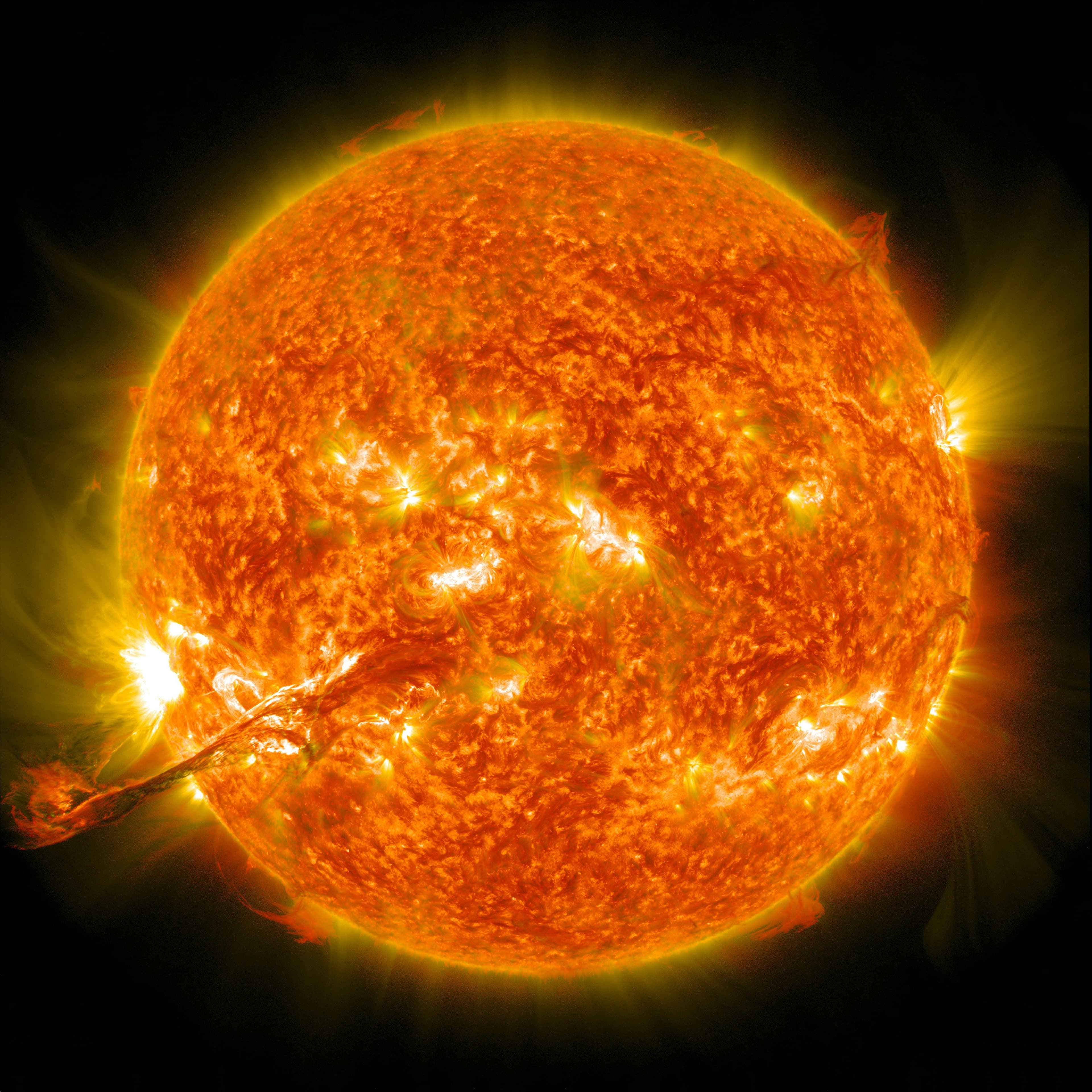
Right now, 65 billion particles from the sun are passing through every square centimetre of your body. Every second. You cannot feel them. You cannot stop them. These particles are called neutrinos. They come from the nuclear furnace at the core of the sun. And they tell us something strange and beautiful about what the sun really is.
What a neutrino is
A neutrino is one of the smallest particles in the universe. It has almost no mass. It carries no electric charge. It barely interacts with anything at all.
That last part is what makes it so strange.
Most particles collide, react, or get absorbed when they hit matter. Neutrinos do none of that. They pass through solid objects as if those objects simply are not there.
Where they come from
The sun produces its energy by fusing hydrogen into helium. Deep in its core, where temperatures reach 15 million degrees, this process runs every second — 600 million tonnes of hydrogen every second.
Neutrinos are a byproduct of that process. They are born in the core, and they leave instantly. While a particle of light takes between 100,000 and 200,000 years to fight its way through the dense solar plasma to the surface, a neutrino exits the sun in 2.3 seconds.
It reaches Earth 8 minutes later.
That means neutrinos give us a live view of what is happening inside the sun right now. Not sunlight from a hundred thousand years ago. The core, as it burns today.
Why they pass through everything
To stop a neutrino, you need mass. A lot of it. Specifically, a block of solid lead one light-year thick — roughly 9.5 trillion kilometres — and even then, a few would get through.
The Earth itself is not much of a barrier. At night, neutrinos from the sun pass straight through the entire planet, up through your mattress, through your body, and out into space on the other side.
To a neutrino, solid rock is as clear as open air.
The reason is simple: atoms are almost entirely empty space. The nucleus of an atom is tiny, and the electrons orbiting it are even tinier. Everything in between is nothing. Neutrinos slip through that nothing without touching anything.
The shape-shifting discovery
For decades, scientists had a problem. They built giant underground detectors to count solar neutrinos, and they kept finding only one third of the expected amount.
Two thirds were missing. Either the sun was broken, or the physics was.
The answer turned out to be stranger than either. Neutrinos can change type in transit.
The sun produces one kind of neutrino — the electron neutrino. But there are three kinds in total: electron, muon, and tau. As neutrinos travel through space, they quietly shift between types. By the time they reach Earth, the original beam has split equally into all three.
Early detectors were only built to catch one type. They were missing the other two entirely.
This discovery — that neutrinos change type — proved they have mass, which they were long assumed not to have. It was a crack in the Standard Model of physics. It earned the Nobel Prize in 2015. And it tells us the universe is not quite as we thought.
What they do to you
Almost nothing — which is itself remarkable.
Over an entire human lifetime, it is estimated that exactly one neutrino will collide with an atom inside your body. One. Your body handles millions of radiation hits every day from rocks, cosmic rays, and the food you eat. One neutrino interaction over 80 years is biologically invisible.
You are transparent to them. And they are transparent to you.
Why scientists study them anyway
Precisely because they pass through everything, neutrinos carry information nothing else can carry.
When a star dies in a supernova explosion, 99% of the energy it releases goes out as neutrinos. The light from the explosion takes hours to fight through the collapsing star. The neutrinos are already gone. Detectors on Earth will register a burst of neutrinos hours before any light arrives — an early warning that a star somewhere in the galaxy has just died.
Neutrinos also come from inside the Earth itself, produced by radioactive decay deep in the mantle. By measuring these, scientists can map what is happening kilometres below the surface without drilling a single hole.
The takeaway
The sun sends far more than light. Every second, it fires trillions of nearly massless particles in every direction. They pass through stars, planets, and people without slowing down. Most of what the sun produces never touches you at all.
The part that does — the light, the warmth, the ultraviolet — is a small slice of a much larger story. Neutrinos are the rest of that story, passing silently through everything, carrying news from the core of the sun directly to Earth in eight minutes flat.
Go Deeper
If you want to explore this topic further:
- Solar neutrino — Wikipedia: Solar neutrino
- Neutrino oscillation — Wikipedia: Neutrino oscillation
- Solar Neutrino Problem — Wikipedia: Solar neutrino problem
David Fink
Founder
David Fink is an engineer, the founder of Sollees, and someone who finds the physics of sunlight genuinely fascinating. He writes about light from a technical perspective — what it is, how it behaves, and why getting it right matters.
Keep reading
 The Hidden Thing Sunlight Does to Your HeartRegular, moderate sun exposure is a health behaviour the body depends on.
 How Sunlight Makes Vitamin DSunlight is not just pleasant to be in. For vitamin D, it is the starting point of a process your body cannot easily replace.
 The physics of sunlight I: The Electromagnetic CocktailBeyond the light you can see lies a spectrum of invisible energy — heat you feel but never see, and radiation powerful enough to reshape your biology.