Biology
The Light You Feel but Never See: Infrared and Your Body
About half of the energy in sunlight is light you will never see. You feel it, though — it is the warmth on your face when you step out of the shade on a cold spring day. That light is infrared, and over the last few decades researchers have found that it does more inside the body than make us warm. Some of it reaches past the skin, and some of it seems to speak directly to the tiny power stations inside our cells.

Light beyond red
Sunlight is a mix of wavelengths. The ones your eyes can see run from violet to red, and just past the deepest red, where your eyes stop working, infrared begins. By energy, sunlight at the ground is roughly half infrared, a little over 40 percent visible light, and only a small slice ultraviolet.
Scientists split infrared into three bands. Infrared-A sits closest to red light, Infrared-B
comes next, and Infrared-C has the longest waves of all. The difference matters, because each band behaves very differently once it meets your body.
How deep it goes
Your body is mostly water, and water decides where infrared ends up. The longer infrared waves, B and C, are soaked up almost at once by the water in the outermost layer of your skin. That is where your heat sensors sit, which is why a sauna or a fire can feel scorching on the surface long before anything deeper has warmed up.
Infrared-A is different. Water happens to absorb very little light at these wavelengths, so IR-A slips through the surface and travels up to about five millimetres into the skin, deep enough to reach the layer of fat and blood vessels underneath. Germany's Federal Office for Radiation Protection describes it as the part of infrared that can act on that deeper tissue directly, and notes that infrared can help local blood flow and ease muscle
tension.

This is why the sun can feel so gentle and still warm you right through. Most of the infrared in sunlight is IR-A, so a good share of its warmth lands below the surface instead of on it.
Light for your cells
Almost every cell in your body contains mitochondria, tiny structures that turn the food you eat into the energy your cells run on, a molecule called ATP. Cells that work hard, like muscle and nerve cells, are packed with them.
Inside each mitochondrion sits an enzyme called cytochrome c oxidase, one of the last steps in the chain that makes ATP. It turns out that this enzyme absorbs light; mainly deep red light and near-infrared, the IR-A part of the spectrum. The leading explanation, set out by the photobiologist Michael Hamblin and others, is that the light knocks loose a molecule that slows the enzyme down, so the energy chain runs more freely and the cell makes more ATP.
One recent study shows how far that effect can reach. In 2024, researchers in London shone deep red light at 670 nanometres on healthy volunteers for 15 minutes before giving them a sugary drink. Over the next two hours, their blood sugar rose 27.7 percent less than in a group whose lamp stayed off. The researchers' explanation is simple: mitochondria that are working harder burn more glucose.
Some scientists go further still. Scott Zimmerman and Russel Reiter have proposed that the near-infrared in sunlight prompts mitochondria to make their own melatonin, not as a sleep signal, but as a local protector against cell damage. It is a hypothesis, not a settled finding. But it raises a question I find hard to let go of: what do our cells miss when we spend our days under lights that contain almost no infrared at all.
What red light therapy is
Red light therapy takes this cell-level effect and tries to put it to work. The scientific name is photobiomodulation, and it means shining low-power red or near-infrared light, from LEDs or weak lasers, onto a part of the body. It does not burn or heat the skin, and it uses no ultraviolet. Its roots go back almost 50 years, to the Hungarian doctor Endre Mester, and NASA later tested red LEDs for plant growth and wound healing in space.
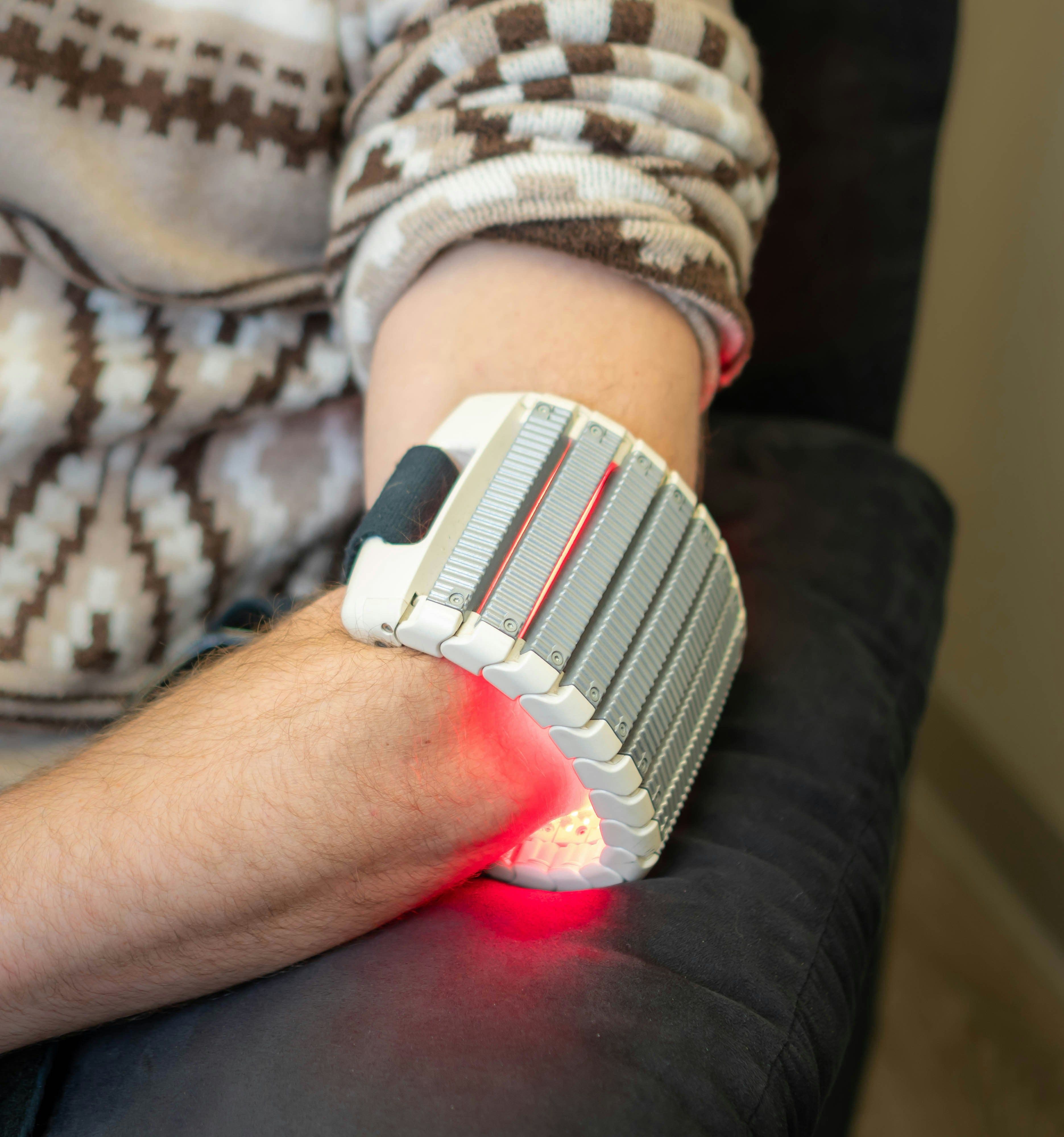
Wavelength matters a great deal. Researchers have found that most effects come from red light around 600 to 700 nanometres and near-infrared from about 780 nanometres up, while the band in between works poorly, because cytochrome c oxidase absorbs little light there. Dose matters too. Small amounts of light seem to stimulate cells, and much larger amounts can have the opposite effect.
What the research says it may help with
The strongest evidence comes from cancer care. Treatment for some cancers often causes painful sores in the mouth, and an international expert group (MASCC/ISOO) now recommends specific low-level laser treatment inside the mouth to help prevent them in certain groups of adult patients.
For hair loss, the picture is also fairly solid: several home-use devices for pattern hair loss have been cleared by the US Food and Drug Administration, and a review of seven controlled trials found more hair growth than with
sham devices.
For skin, wrinkles, scars and acne, Cleveland Clinic describes the early results as promising, but notes that many studies are small, lack a placebo group, or were done in animals or cells. Pain, joint problems and wound healing are being studied too, with mixed results. And for some of the claims you may see online, such as weight loss, cellulite or depression, Cleveland Clinic says there is no scientific evidence.
The treatment itself appears safe when used as directed and for short periods. The eyes need protection, though, and nobody yet knows the long-term effects of using home-devices regularly.
What this means in practice
A red light panel delivers one or two narrow wavelengths, aimed at one spot, for a set number of minutes. Sunlight is something else: a broad mix that carries red light and near-infrared together with all the other colours, every time you step outside. That does not make the two interchangeable, and the studies above tested specific devices, not sunshine. But it is a reminder that the light our cells evolved with always had a large share of red and infrared in it.
Indoors, that share has mostly gone. The LEDs and screens we live under give off very little infrared, which is one more reason to spend part of your day outside — and to notice the warmth on your skin when you do. You feel the infrared every time the sun touches your face. It turns out your cells may feel it
too.
Go Deeper
If you want to explore this topic further:
- Infrared light — Wikipedia: Infrared
- How infrared enters the skin — Federal Office for Radiation Protection (BfS): Applications of infrared radiation
- How light acts on mitochondria — IEEE J Sel Top Quantum Electron: "Proposed Mechanisms of Photobiomodulation or Low-Level Light Therapy", de Freitas & Hamblin (2016)
- Red light and blood sugar — Journal of Biophotonics: "Light stimulation of
mitochondria reduces blood glucose levels", Powner & Jeffery (2024) - What red light therapy can and cannot do — Cleveland Clinic: Red Light Therapy
Heidi Fink
Content and project lead, Sollees
Heidi is on a mission to share honest, well-grounded information about sunlight and health. She is especially drawn to the biology of it all — how our bodies are wired to respond to light, and what that means for the way we live.
Keep reading
 The Hidden Thing Sunlight Does to Your HeartRegular, moderate sun exposure is a health behaviour the body depends on.
 How Sunlight Makes Vitamin DSunlight is not just pleasant to be in. For vitamin D, it is the starting point of a process your body cannot easily replace.
 The physics of sunlight I: The Electromagnetic CocktailBeyond the light you can see lies a spectrum of invisible energy — heat you feel but never see, and radiation powerful enough to reshape your biology.