Biology
Brighter, Bluer, Colder: What LED Light Means for Your Eyes
Look up at the light above you right now. It is most likely coming from a LED, and 10 years ago it properly did not. In little more than a decade, the light we live under indoors has changed more than it did in the century before. LEDs save energy and last for years, and that is a real gain. But they also make a different kind of light, and I wanted to know what that difference means for the organ that takes it all in: your eyes. Some of the worries turned out to be well founded. Others, especially about screens, turned out to point at the wrong culprit.

From glowing wire to glowing chip
A halogen or old incandescent bulb makes light the way the sun does, by heating something until it glows. That gives a smooth, broad spectrum, weighted towards warm red and full of infrared you cannot see but can feel as heat.
A white LED works differently. Inside it sits a chip that gives off strong blue light, coated with a yellow layer that turns part of that blue into other colours. Your eye adds the mix together and sees white. The result has a sharp blue peak, very little deep red, and almost no infrared at all.
In Europe, the shift happened by law as well as by choice. From September 2018, the EU stopped the production of ordinary mains-voltage halogen bulbs to save energy, and today LEDs light most homes, offices and schools — very often in cool white tones that are rich in blue.
Blue light and the retina
At the back of your eye sits the retina, a thin layer of light-sensing cells that turns what you see into signals for the brain. Blue light carries more energy than red, and the front of the eye lets almost all of it through to the retina. In high enough doses, it can damage those cells — scientists call this the blue light hazard.
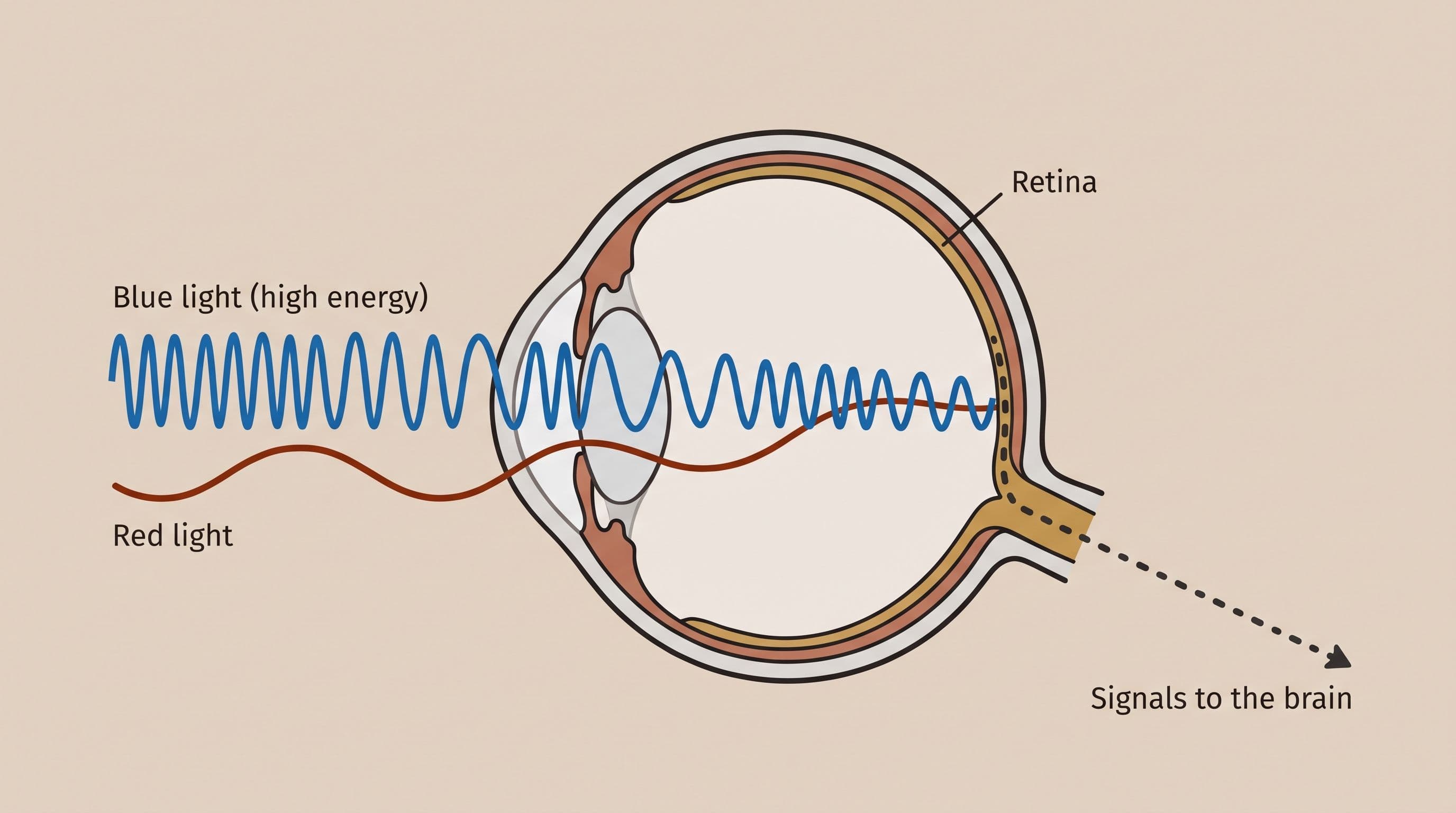
The most thorough look at what this means for LED lighting comes from ANSES, the French agency for health and safety. In 2019, after reviewing the research, it confirmed that blue light is toxic to the retina. It found short-term effects from intense exposure, and long-term effects from years of exposure that may play a part in age-related macular degeneration, a common cause of failing sight in older people. It also noted that the retina seems more vulnerable at night.
ANSES did not say that ordinary LED bulbs are dangerous. But they recommend to limit the LED products with the most blue light, keeping the brightest and bluest ones out of general sale, and protecting children in particular, because a child's lens lets through more blue light than an adult's.
What screens really do to your eyes
Here the story turns, and I was surprised by it. Screens do give off blue light, but very little of it. According to the researchers behind a large review from 2023, the blue light your eyes get from a computer screen is about a thousandth of what they get from daylight. The American Academy of Ophthalmology says that the small amount of blue light from screens has never been shown to harm the eyes.
The tired, dry, burning eyes after a long day at the screen are real, but they have another cause. When you look at a screen, you blink about half as often as usual, so the surface of your eye dries out. Your eyes also hold the same close focus for hours. Eye doctors call this digital eye strain, and it passes once you rest.
That is also why blue-light glasses do not seem to help. A Cochrane review of 17 trials found tha
t they made little or no difference to eye strain from computer work compared with ordinary lenses. Most of them filter out only 10 to 25 percent of blue light anyway.
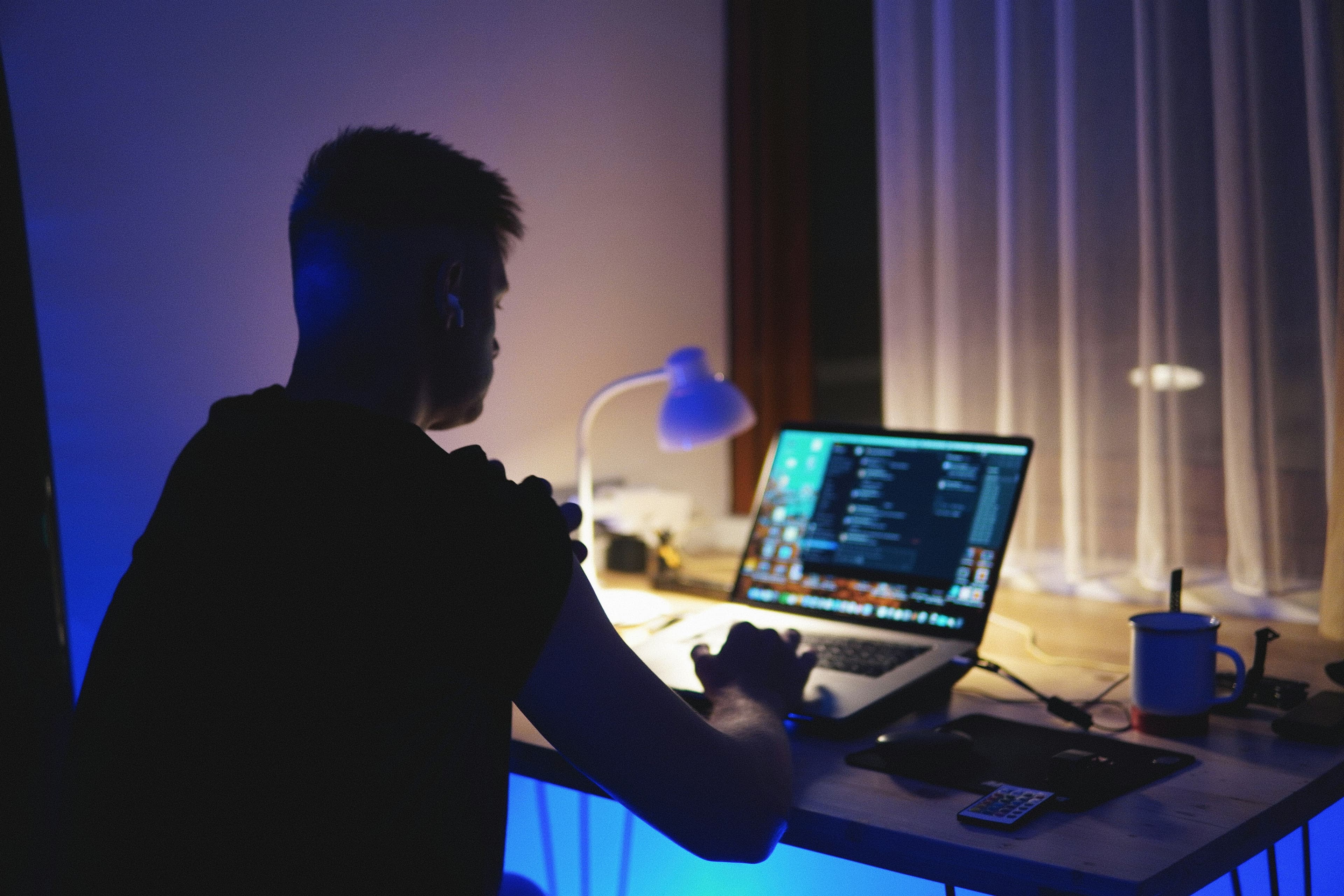
Where screen light does matter is at night. Blue light is the strongest signal to your body clock that it is daytime, so a bright screen late in the evening can hold back melatonin and push your sleep later. ANSES pointed to exactly this, especially for children.
Flicker you cannot see
Many LED lamps do not shine evenly. Depending on the electronics inside, their light can rise and fall many times a second, too fast to notice. ANSES found that a lot of LED lamps vary in strength this way and linked it to headaches and tired eyes, and it asked for this flicker to be kept as low as possible in all lights and screens.
The missing red
The newest criticism of LED light points at what it leaves out. In another article on infrared, Heidi Fink wrote about how deep red and near-infrared light act on the mitochondria in our cells. The retina is one of the most energy-hungry tissues in the body, and Glen Jeffery at University College London has spent years studying how long-wavelength light affects it.
In a recent study, his team tested the colour vision of office workers who had spent years under LED lighting. Some of them then got an ordinary incandescent desk lamp for two weeks. Their ability to tell faint colour differences improved by about 25 percent on average and stayed better for weeks afterwards, while the group who kept only LED light saw no change.
It was a small study, with just 22 people, and it measured one kind of vision test, not long-term eye health. But it suggests that what an LED leaves out of its spectrum may matter as much as the blue it puts in.
Children, screens and the outdoors
There is one eye problem where indoor life clearly plays a part: myopia, or short-sightedness, where distant things look blurry. It usually starts in childhood and has become far more common in many parts of the world. The cause is not the blue light from screens. It seems to be the combination of close-up work for hours on end and too little time in bright daylight.
The clearest evidence comes from a trial in Guangzhou, China, published in 2015. Six-year-olds in six schools got one extra 40-minute class outdoors every school day, while children in six other schools kept their usual schedule. After three years, 30 percent of the outdoor group had become short-sighted, against almost 40 percent of the others.

The researchers think the brightness of outdoor light is part of the reason, possibly through the release of dopamine, a signalling chemical in the retina that helps control how the eye grows. Indoor light, even from a bright LED, is only a small fraction of what a child gets outside.
What this means in practice
None of this means you should rip out your LED lights. It means paying attention to which ones you choose and when you use them. Warm white bulbs give off less blue light than cool white ones, and they belong in the rooms you spend your evenings in. Try not to look straight into bright, bare LED points, and when the evening comes, dim the lights and turn the screens down or put them away.
For tired eyes at the screen, the advice from eye doctors is simple: every 20 minutes, look at something about six metres away for 20 seconds, and remember to blink. And for children especially, the best thing for their eyes may also be the simplest — time outside, in real daylight, every day.
LED light is efficient, long-lasting and mostly safe. But it is not daylight, and it was never designed to be. Your eyes still need the real thing.
Go Deeper
If you want to explore this topic further:
- Digital eye strain — Wikipedia: Computer vision syndrome
- LEDs and blue light — ANSES: "LEDs: ANSES's recommendations for limiting exposure to blue light" (2019)
- Blue-light glasses — Cochrane Database of Systematic Reviews: "Blue-light filtering spectacle lenses for visual performance, sleep, and macular health in adults", Singh et al. (2023)
- LED light and colour vision — Scientific Reports: "LED lighting (350–650nm) undermines human visual performance unless supplemented by wider spectra (400–1500nm+) like daylight", Barrett & Jeffery (2026)
- Outdoor time and short-sightedness — JAMA: "Effect of time spent outdoors at school on the development of myopia among children in China", He et al. (2015)
David Fink
Founder
David Fink is an engineer, the founder of Sollees, and someone who finds the physics of sunlight genuinely fascinating. He writes about light from a technical perspective — what it is, how it behaves, and why getting it right matters.
Keep reading
 The Light You Feel but Never See: Infrared and Your BodyDiscover the invisible half of sunlight that reaches deep into your tissues, and why living under modern, infrared-free indoor lighting might matter to your cells.
 The Hidden Thing Sunlight Does to Your HeartRegular, moderate sun exposure is a health behaviour the body depends on.
 How Sunlight Makes Vitamin DSunlight is not just pleasant to be in. For vitamin D, it is the starting point of a process your body cannot easily replace.