Visible Light TheoryColours of the sky
Last updated
Why the sky is blue: Rayleigh scattering
Air molecules scatter short wavelengths far more than long ones. The sky is the scattered part of sunlight, and blue wins by a wide margin.
David FinkFounder1 min read
When light meets a particle much smaller than its wavelength, the particle re-radiates a little of it in all directions. How much depends steeply on the wavelength.
The fourth power
Lord Rayleigh showed in 1871 that the scattered intensity from small particles goes as the inverse fourth power of the wavelength:
Blue light at 450 nm has a wavelength about 0.7 times that of red light at 650 nm, so it is scattered about times more strongly. Look anywhere in the sky except at the sun and you are seeing scattered light, so you see blue.
Why not violet?
Violet is scattered even more than blue, but there is less of it in sunlight, some is absorbed high in the atmosphere, and the eye is less sensitive to it. The mixture that reaches you reads as sky blue.


An interactive view
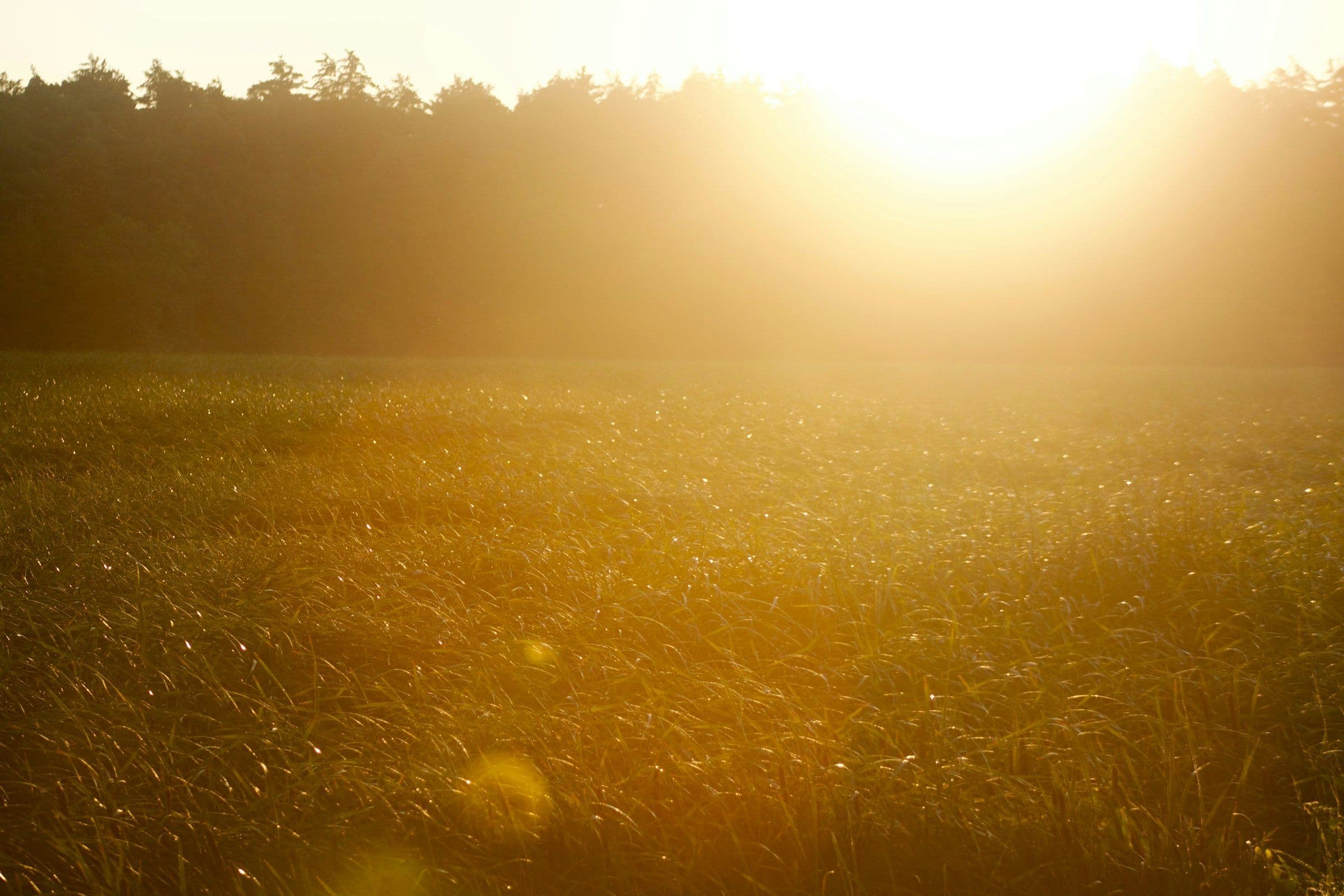
The other half of the effect, what happens to the light that is not scattered, is on the next page: Why sunsets turn red.
Sources
- On the light from the sky, its polarization and colour. Strutt, J. W. (Lord Rayleigh) (1871). Philosophical Magazine 41(271).doi:10.1080/14786447108640452
Further reading